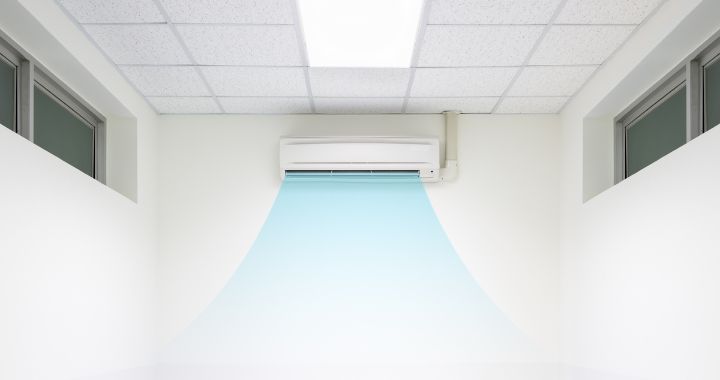
Choosing the right size air conditioner is essential for keeping your home comfortable and your energy bills manageable.
An undersized unit will struggle to cool your space and run constantly, while an oversized unit will cycle on and off frequently, wasting energy and failing to control humidity properly.
This guide will help you understand air conditioner sizing and determine the right capacity for your home.
To get the best solution, a professional assessment is recommended so if you’re looking for air conditioning for your home, get in touch with our team today for a free site survey.
Air conditioner size chart: Quick reference guide
Use this chart to find the appropriate cooling capacity for your room:
| Room Size (m²) | Room Size (sq ft) | BTU Required | kW Equivalent | Typical Room Type |
|---|---|---|---|---|
| 9–14 m² | 100–150 sq ft | 5,000–7,000 | 1.5–2 kW | Small bedroom, study |
| 14–23 m² | 150–250 sq ft | 7,000–9,000 | 2–2.5 kW | Medium bedroom, home office |
| 23–33 m² | 250–350 sq ft | 9,000–12,000 | 2.5–3.5 kW | Large room, small living room |
| 33–42 m² | 350–450 sq ft | 12,000–14,000 | 3.5–4 kW | Living room, master bedroom |
| 42–51 m² | 450–550 sq ft | 14,000–18,000 | 4–5 kW | Large living room, open-plan space |
| 51–70 m² | 550–750 sq ft | 18,000–24,000 | 5–7 kW | Very large living space |
Note: These figures are starting points. You’ll need to adjust based on other factors such as sun exposure, room purpose, and occupancy (see adjustment factors below).
How to calculate your air conditioner size
Step 1: Measure your room dimensions
Calculate your room’s area by measuring length and width:
- Length x Width = Square Metres (or square feet)
- For irregular rooms, divide into sections and add the totals
- Include alcoves and bay window areas in your measurement
Step 2: Determine base BTU requirement
Use the chart above to find the BTU your air conditioner requires for your room size, or calculate using these simple formulas:
UK Formula:
- Square metres x 500 = Base BTU requirement OR Square footage x 25
Converting to kW:
- Divide BTU by 3,412 to get kW capacity
Step 3: Apply adjustment factors
Adjust your base calculation using the factors below to account for your room’s specific characteristics.
Adjustment factors: Fine-tuning your calculation
Once you have your base BTU calculation, adjust for these common factors:
- Add 10% if the room has high sun exposure (south-facing or large windows)
- Reduce by 10% if the room is extremely shaded (trees, north-facing, or little direct sunlight)
- Add 4,000 BTU if placing the unit in a kitchen due to heat from ovens and cooking appliances
- Add 600 BTU for every additional person if more than two people frequently inhabit the area
These adjustments ensure your air conditioner can handle your room’s actual cooling demands, not just the basic square footage.
Understanding BTU and kW ratings
BTU (British Thermal Unit) measures the amount of heat an air conditioner can remove from a room per hour and in turn how much energy it uses. Higher BTU ratings indicate more cooling power.
kW (Kilowatt) is the metric measurement more commonly used in the UK. Both indicate cooling capacity, with BTU being the traditional measure and kW increasingly common on modern systems.
Why air conditioning unit size matters
Getting your AC size right affects comfort, efficiency, and your system’s lifespan.
Problems with undersized AC units
An air conditioner that’s too small will:
- Struggle to reach your desired temperature on hot days
- Run constantly, significantly increasing electricity bills
- Wear out much faster due to continuous operation
- Create an uncomfortable environment with poor temperature control
Problems with oversized AC units
An air conditioner that’s too large will:
- Cool the room too quickly, then shut off repeatedly (short cycling)
- Fail to remove humidity effectively, leaving the room feeling clammy
- Waste energy through frequent start-up cycles
- Experience more component wear from constant on/off cycling
- Cost more upfront for capacity you don’t need
Proper sizing ensures your air conditioner runs efficiently, maintains comfortable temperatures all year round, controls humidity effectively, and lasts for its full expected lifespan.
Types of air conditioning systems and sizing
Different system types have specific sizing considerations:
Single split systems
Single split systems have one indoor unit connected to one outdoor unit, making them ideal for cooling individual rooms.
The sizing approach involves calculating each room separately based on its unique characteristics and selecting a unit sized specifically for that space. This is the most straightforward method of determining capacity.
Single split wall mounted air conditioners are best suited for single rooms that require targeted cooling, such as bedrooms, home offices, and living rooms, and they work particularly well in retrofit installations where only selected areas need air conditioning.
Multi-split systems
Multi-split systems connect multiple indoor units (typically 2-5) to a single outdoor unit, allowing independent temperature control in different rooms.
Determining the right size involves calculating the cooling requirement for each room individually, ensuring each indoor unit is correctly matched to its own space, and making sure the combined demand does not exceed the outdoor unit’s capacity.
These systems are ideal for multiple rooms that need air conditioning, for homes that prefer using one outdoor unit rather than several, and for situations where different rooms have varying cooling needs. A professional assessment must ensure the outdoor unit can adequately support all connected indoor units for reliable performance.
VRF/VRV systems
Variable refrigerant flow systems provide advanced climate control, ideal for larger properties or buildings with multiple rooms with differing requirements like hotels or schools and colleges.
A professional should carry out their sizing calculation, as it takes into account usage patterns across several zones, and involves a far more complex process than standard split-system calculations.

Room-specific sizing tips
Bedrooms
Bedrooms typically have lower heat loads and standard sizing usually works well. However, prioritise quiet operation, and check the unit’s noise rating (dB) alongside capacity. Units with sleep modes are ideal for overnight comfort.
Living rooms
Account for entertainment equipment, sun exposure from windows, and typical occupancy. Open-plan large spaces may benefit from multi-split systems for better coverage and zoning.
Home offices
Modern home offices with computers, monitors, and equipment generate additional heat. Consider this when sizing, and position the unit for comfortable workspace temperatures.
Kitchens
Always add 4,000 BTU to your base calculation for kitchens to account for heat generating appliances. Position the unit away from cooking areas and coordinate with your extraction unit.
Conservatories
Conservatories with extensive glass surfaces need significantly more capacity, typically 25-40% more than standard rooms. South-facing conservatories require maximum capacity for effective cooling.
Key factors affecting air conditioner performance
Beyond basic sizing, several factors influence how well your air conditioner performs:
Insulation quality
Well-insulated modern homes with double or triple glazing need less capacity than older properties with single glazing and poor insulation. If your home has older windows and limited insulation, consider choosing the higher end of the recommended BTU range.
Ceiling height
Standard calculations assume typical ceiling heights around 2.4 metres (8 feet). If you have high ceilings (3 metres or more), you’ll need additional capacity to cool the larger air volume effectively.
Common sizing mistakes to avoid
Guessing room size: Always measure accurately rather than estimating. Small measurement mistakes can lead to significant sizing errors.
Assuming bigger is better: Bigger units create as many problems as undersized ones. Match capacity to your actual needs.
Ignoring sun exposure: A south-facing room needs more capacity than an identical north-facing room. Apply the adjustment factors.
Forgetting room purpose: Kitchens and home offices have special requirements that standard calculations don’t account for.
Using American guides: US and UK sizing standards differ. Always use UK-appropriate calculations and charts.
DIY sizing for complex installations: While single-room installations can often be sized using guides like this, multiple rooms or whole-house air conditioning units benefit from professional assessment.
Get expert sizing help from Mechcool
Choosing an air conditioner with the correct size ensures comfort, efficiency, and longevity. While understanding the basics helps you make informed decisions, a professional assessment guarantees perfect results tailored to your specific property.
At Mechcool, our experienced engineers have been installing air conditioning systems across Sussex and Surrey for over 20 years. We provide free site surveys and quotes, taking all factors into account to recommend the perfectly sized system for your needs.
Get in touch with us today for a cost effective solution!
Frequently asked questions
No, different rooms require different capacities based on their size, sun exposure, purpose, and characteristics. A bedroom might need a smaller unit than a south-facing living room, while a kitchen needs extra capacity due to heat from cooking appliances. Each room should be assessed individually to ensure optimal performance and efficiency.
Signs of an undersized unit include the room never reaching the desired temperature, the system running constantly, and high energy bills. An oversized unit will cycle on and off frequently (short cycling), struggle to control humidity leaving the room feeling damp, and may cause uncomfortable temperature swings. If you’re experiencing any of these issues, contact our team for a professional assessment.
For single-room installations, our sizing guide provides a good starting point for understanding your requirements. However, professional sizing ensures accuracy by accounting for all variables including insulation quality, exact room dimensions, sun exposure patterns, and building characteristics. For multi-room systems, whole-house installations, or complex layouts, professional assessment is essential.